Wednesday, January 24, 2018

Three Lessons Marketers Can Learn From Cable News

email marketing for bloggers

I’m a bit of a cable news junkie.

Now, I don’t watch it often, but am generally more interested how a news product can draw people in hold their attention for hours, and keep them coming back everyday.

But why is this so interesting? And why should marketers care?

Because news itself can be pretty boring.

For your average 9-5 American with two kids and a mortgage, there’s not a big reason to watch news.

And the thing is, news outlets know this. They know reporting on the latest earthquake in Oklahoma is mundane and doesn’t matter.

Unless you spice it up a little bit. Get people’s emotions involved. Make viewers scared or angry.

So here’s why all marketers can take a lesson from cable news.

Cable News is Entertainment Masquerading as News

Their expertise does not lie in reporting the news or helping you understand the world’s events. Instead, they’re experts at messaging and grabbing your attention and holding it for hours, everyday. Because the only way to get viewers is to entertain.

It’s designed for channel changers. Those people with their hand on the television remote, flipping through channels. Cable news is designed to capture that 1-2 seconds of the channel changer, and holding that attention.

In this post, I’m going to examine the different ways news programs (primarily CNN and Fox) use emotions and classic Hollywood-style entertainment techniques to grab viewer’s attention and make sure they come back night after night. Then, we’ll see how marketers can steal these for their own gain.

1. Use Numbers to Your Advantage

Numbers can tell a story. They let the viewer understand impacts and effects. Numbers can be attention grabbing.

And cable outlets know this. They love using numbers, especially when it relates to danger.

Don’t believe me? Just wait for a hurricane or any other major natural disaster.

You’ll see cable and other news programs use numbers whenever a hurricane hits the U.S. And it’s generally meant for fear mongering. It’s typically “5 million people in the storm’s path” and “13,000 homes underwater” and “20 million people under evacuation orders”. It’s forceful messaging that grabs attention.

Here, in big text, Fox tells viewers how many are without power:

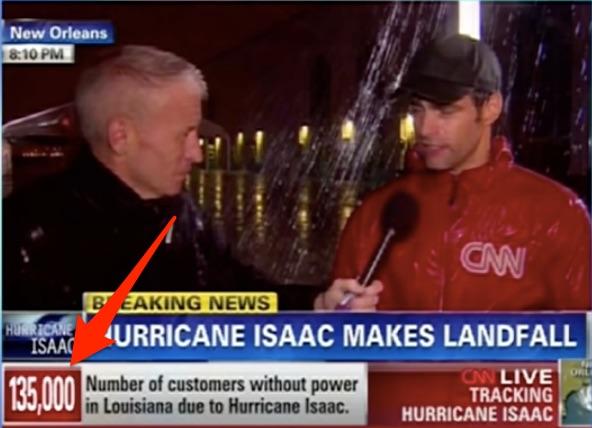
CNN uses a different number, but makes it clear so the channel changers see it right away (and how could they leave out Anderson Cooper and his correspondent standing in the pouring rain):
During Hurricane Matthew, Fox reports on evacuation numbers:

Here’s how CNN reports on Hurricane Maria:

Rescues underway in Puerto Rico as Millions Without Power captures the eye. It takes a few seconds to read, but draws you in. Who would turn the channel after reading that banner?

Another hurricane, and more attention grabbing numbers. And if that wasn’t enough, they also threw one of their correspondents into a hurricane!
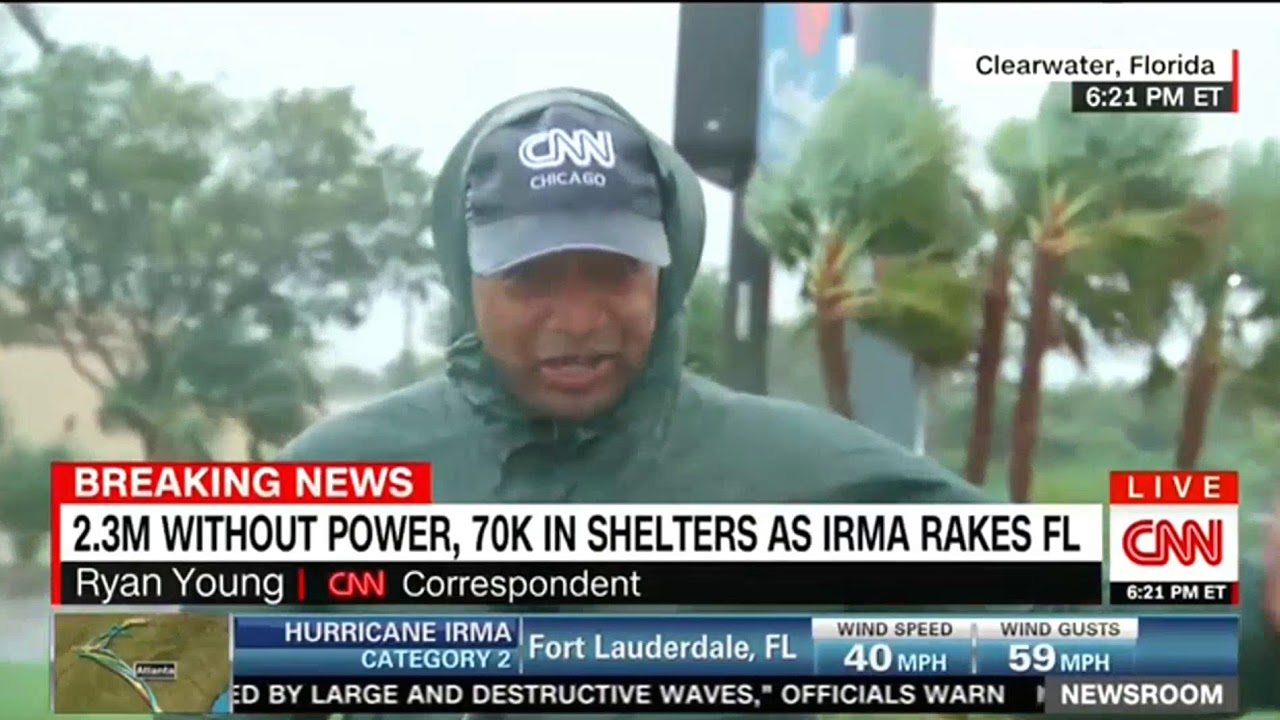
This correspondent is away from the hurricane, but that doesn’t stop them from throwing the Millions Could Be Without Electricity For Weeks banner:

You get the idea. Numbers grab people’s attention. They may not hold the attention for a long time, but they do catch the eye.

Now, let’s look at how some marketers are using numbers to their advantage, and how you can as well.

Lessons For Marketers

Some marketers use numbers as social proof. Help Scout uses numbers to show how many customers they have:

Or to encourage you to signup for their email list:

LifeLock uses numbers to sow fear (more on that later) for visitors – and make their product the protection:

It’s also important to note that they’re using a recent data breach to sell their product. If marketing is all about timing, then LifeLock is getting their marketing right and profiting from it by pouncing on opportunities.

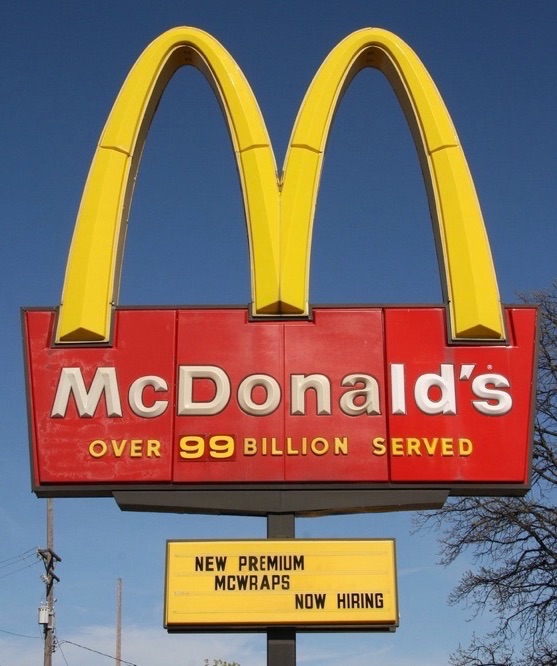
McDonalds used to post the “Billions and Billions served” under the golden arches. Here they give a more specific number while keeping the emphasis, billions served, the same.
Rainforest Trust, an organization that preserves forests, tells visitors how many acres of forest they’ve saved:
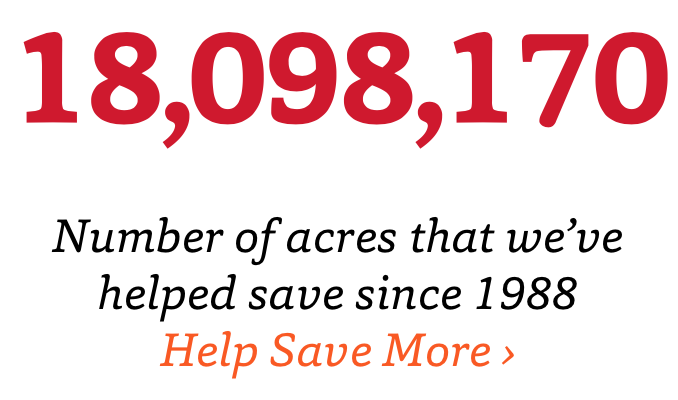
Combine that with a call to action to save more land, and it makes for a great use of numbers to draw donations.

I’ll frequently use numbers in blog posts to capture reader’s attention. In one of my videos, I give the reader a specific number:

Think about it – what headline would get more people to read my article (or in this case, watch the video):

How I Built 23,540 Unique Links to NeilPatel.com

Or this headline:

How I Built Links to NeilPatel.com

The number adds to the impact and gives the headline more of a “punch”. I didn’t just build a few links – I built over 20,000 links to the Neil Patel blog. I guarantee that I got more views on this video because I gave readers a specific number.

On the Quick Sprout blog, I’ve used this advertisement for many years with a lot of success:

I didn’t just increase pageviews. I helped a company grow to 500 million pageviews.

In this video, I give viewers a few numbers to chew on in my intro:

What’s the message here? Rich people listen to podcasts. The impact? 60% of podcast listeners make over $150,000. And they listen to roughly 5 hours of podcasts per week.

I used the cable news model – what’s the story, and how do you capture people’s attention using numbers to explain the impact?

So, how can you use numbers to persuade? Here are a few ideas:

  • Try adding numbers for social proof. How many customers do you have? If you have a lot relative to the market you’re in, put it on your homepage. Let people know how many people are using your products and services.
  • Add numbers in testimonials. You didn’t just save a customer some money. How much did you save them?
  • Add numbers to the results you achieved. This is particularly useful if you’re a freelancer. You didn’t just help Widget’s Inc improve conversions; you helped them double their conversions in 3 months. It’s more specific, and packs a punch. An x increase in x amount of time.

Now let’s move onto another favorite tactic of cable news outlets, instilling fear. What better way to hold a viewer’s attention?

2. Fear Will Grab Attention

Watching news media outlets in the summer and fall of 2014, you’d think that walking outside would make you susceptible to Ebola. This is despite four cases of ebola and just one death.

This CNN headline takes advantage of two things people are scared of – deadly diseases and terrorist organizations.

If you’re flipping through channels, what does this headline do to you? It grabs your attention. Makes you stop and turn up the volume, lean in, pay attention, and maybe makes you a little scared. For some people, it may make them think the end of the world is near.

In this way, fear picks up where the numbers left off. The numbers will capture the eye of channel surfers, and the emotion of fear will keep them glued to you for hours.

CNN wasn’t alone with the fear-mongering. Here’s the version from Fox:

Did any of these things come true? Was Ebola used as a biological agent? Did terrorist organizations contaminate the water supply with the Ebola virus and hurt millions?

Of course not. But it’s easy to say it now. Back then, Ebola covered the news cycle. People were scared. So the headlines that cable news outlets used capitalized on that fear (which news itself built) and only grew that fear that most people already had.

Just watch as Jon Stewart brilliantly tears down the news media’s attempts to dramatize the Ebola outbreak:


So, how can you use fear marketing?

Lessons for Marketers

Perhaps the most common use of fear is the Fear Of Missing Out (FOMO). And with FOMO, you can use two classic tactics – scarcity and urgency.

This Facebook ad has a good message. Anyone that’s scrolling through Facebook, sees this ad, and likes the shirt will buy it. It’s limited edition, meaning that it won’t be around for a long time, and now there’s only a few left in stock? Where do I place my order?

This Facebook ad has a simple FOMO message. The pre-sale is available now. Get your tickets before anyone else or else you’ll miss out.

The “best worst movie” The Room recently had a nationwide one-day special screening. It spread via word of mouth and some press coverage:

Needless to say, when people couldn’t make it, FOMO triggered and they were pretty upset:

Marketers use FOMO for a reason. Because it works really well. As long as you have a product or service that people want and value, adding some scarcity to it will make people buy it up as quickly as possible.

Think about it – if your product is widely available, will anyone be in a hurry to buy it? Probably not. They may even rethink buying it. But adding a little scarcity to it will make people value it more and makes them more likely to buy.

I’ve used FOMO before to promote some of my webinars:
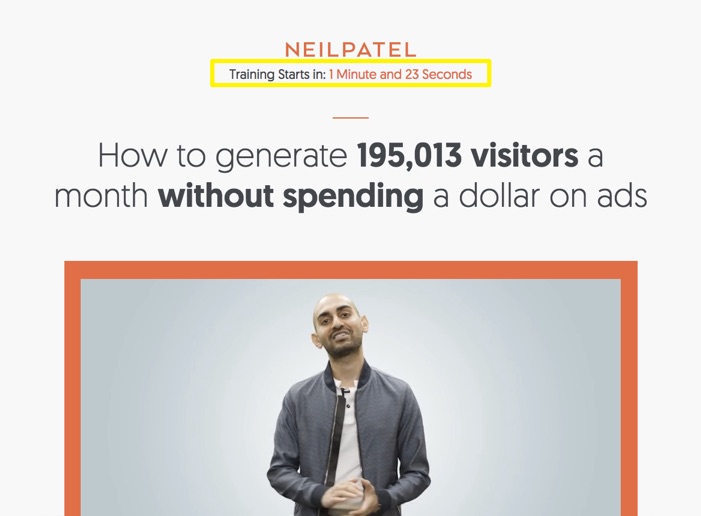
My webinar is starting in two minutes, better not miss it!

The other way marketers use fear is to buy some protection against a threat. We saw the example above with Lifelock.

Millions of people potentially have their identity stolen? And we sell identity theft protection? Cha-ching!

Ramit Sethi wants to make it clear – use his courses and you’ll learn how to make more money. If you don’t use it, you’re not making your earnings potential (thus you’re Missing Out on money that could be yours):
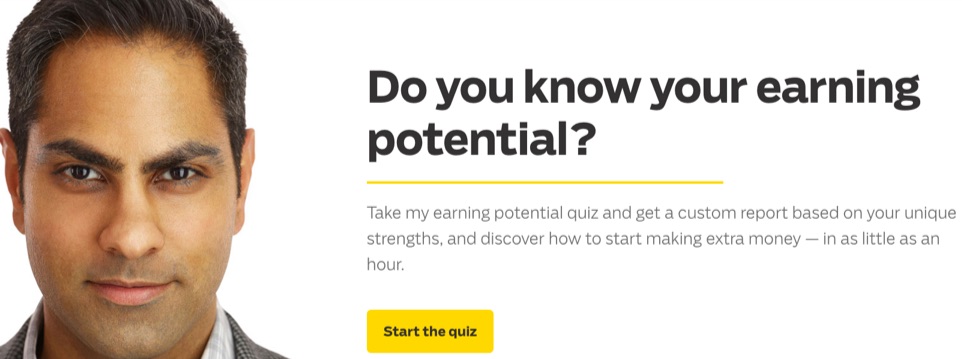
The quiz is a lead generation tool. Start the quiz, give them your email to get the results, and you’ll be thrown into a drip campaign in no time. And then start making more money in “as little as an hour”. Who could pass that up?
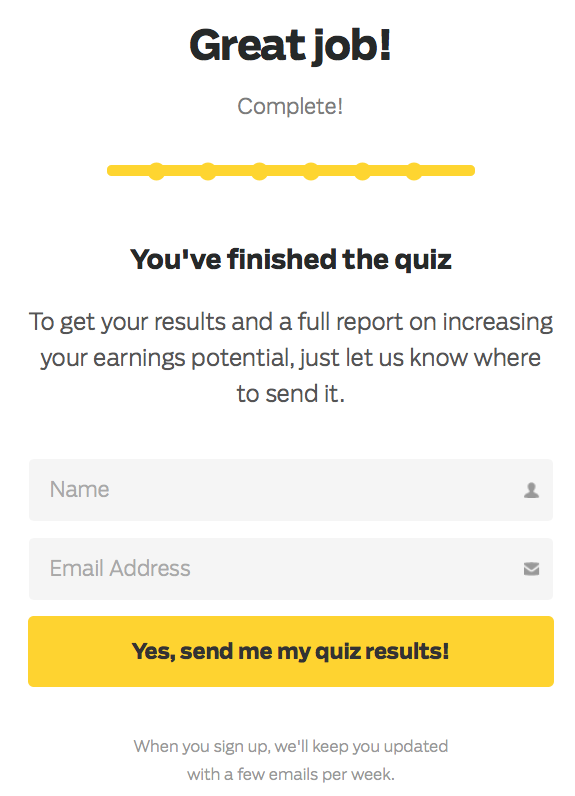
Ramit Sethi uses FOMO marketing and quizzes to grow his email list and generate leads for his online courses

Viruses and malware spreading across computers isn’t as common as it once was, but customers are still fearful of their computer becoming “infected”. And Symantec marketers use that fear:

These marketers use the fear as a lead generation tool. Who’s clicking on this link and reviewing the cleanup plan? Time to retarget them and sell our antivirus software.

Use fear at the right times. Marketing is about timing; so don’t rely on fear all the time. Use it at the appropriate time and it will be more effective for you. Use fear like you’d use a service, only at the right time, for a limited amount of time, and for the appropriate use. FOMO marketing, on the other hand, can be used much more liberally.

3. Use Bold Graphics

Television is the ultimate vision medium, and much of the web is as well. Boring graphics with bland colors won’t draw viewers.

Let’s face it – people don’t want to read a wall of text, and they don’t want to read long headlines. They want fancy colors and beautiful people reading them the news.

When Jeff Zucker took over CNN, he was charged with turning around a ratings decline. One of the first things they did was debut a new graphics package:

Large, bold typography combined with all capitalization on a white background

Have you watched The Situation Room with Wolf Blitzer lately? You’d think their news set was taken straight from a Hollywood movie:
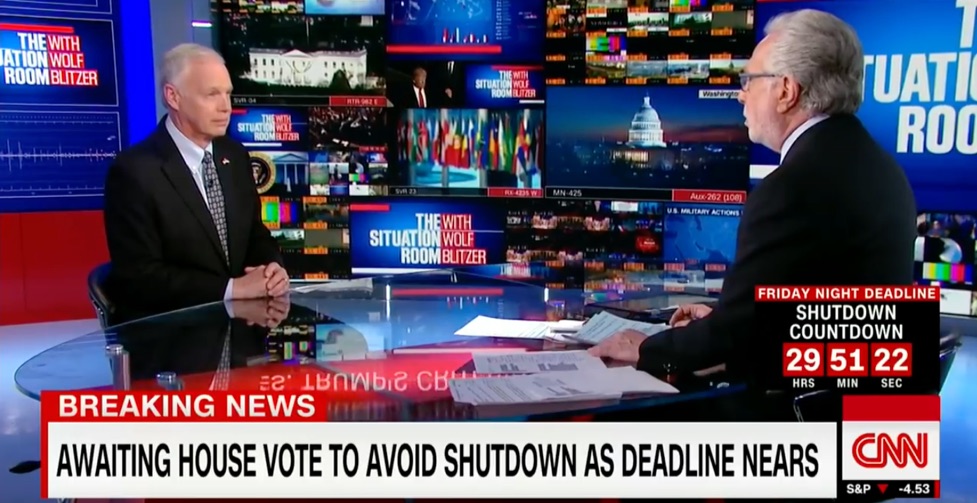
Just take a look at that set!

Dozens of different images on at once (in the background), big typography on the screens, and combined with the Breaking News headline (because apparently everything is breaking news) and the countdown clock makes this the perfect cable news show.

We’re “awaiting”, which means viewers can’t click away, the countdown clock (which starts with at least *29 hours*) means that even if you leave to watch something else, you’ll have to come back and see where the clock is now and continually check to see if the Shutdown Countdown is called off. This is turning the political theater that is Washington, DC into theater television.

Jeff Zucker, I admire you. Well-done sir.

Remember the Ebola fear-mongering we talked about earlier? Take a look at this graphic from CNN:

Can you design a better fear-inducing image if you tried? And the headline, Ebola in America, sounds like it could be a movie.

Lessons For Marketers

The lesson here is to find the balance between big graphics that stand out without overwhelming. Combine great graphics and design with strong messaging (like cable news) and you’ll earn the visitors attention.

The graphics I use on Neil Patel use bold colors combined with simple messaging. Do you want more traffic to your site? Put in your URL and see what I can do for you. The graphics stand out, the message is clear, now the choice is up to the visitor.

The Apple Homepod page uses big typography and beautiful image of the product:

Go ahead and visit the HomePod page and scroll through. Just try to click away. You can’t do it. Why? Because it unfolds like a product description. The graphics keep you scrolling and the copy keeps you reading. The font is big, bold, and stands out against a white background. And the product images draw the eye in.

The Red Cross homepage has one job – get donations from visitors. Here, they don’t use beautiful graphics. Because why would you do that if you want people to donate to a project in need? They need to see sadness or human struggle. So, they go with this:

The little girl holding the little puppy after what appears to be a natural disaster. They’re saved, but sad and clearly in need. How can you help? Give them some money so they “respond to someone in crisis”.

Charity: Water uses graphics to show visitors what they’ll accomplish with a donation – helping rural and poorer countries get access to clean, drinkable water:

This is an example of marketers using an end result to deliver conversions. Clean water coming out of a jug. A happy woman that finally receives uncontaminated water.

It’s not about the organization or the charity, it’s about the mission and what it accomplishes for people. Visitors want to know why they should donate, and this graphic makes it clear.

Conclusion

So why does any of this matter to marketers?

Because it teaches us about messaging, catching and keeping someone’s attention. And in today’s world, it’s a marvel at how cable news does this. They take a boring product (news) and turn it into entertainment that some people can’t look away. And each network generates millions of viewers every hour.

Your product may be exciting to you, but to others it may come across as boring. You should be aware of this and appeal to people’s interests. The classic things that capture people’s attention and hold it. Use numbers to people can understand your impact, use fear to sell, and graphics to keep people’s attention.

What have you, as a marketer, learned from cable news or any great television producers?

About the Author: Neil Patel is the cofounder of Neil Patel Digital.

Google

Why is Your HubSpot Content Failing You?

email marketing effectiveness statistics

So, you’ve gotten on the Inbound Marketing train, and you’re slowly but surely getting the giant machine rolling. You bought the HubSpot subscription and you’re getting familiar with the software. You’ve been pouring all of your blood, sweat, and tears into creating what you think is great content — content that you’re sure people can’t wait to engage with you about!

Then you look at your engagement data. *crickets*

What’s this about? Your content is amazing! Why is your HubSpot content failing you?

FaceBook

Tuesday, January 23, 2018

Business and Leadership Lessons From One of America’s Top Turnaround Executives

email marketing lead generation

You may not have heard of Alan Mulally, but he’s led one of the best turnarounds in modern American business history.

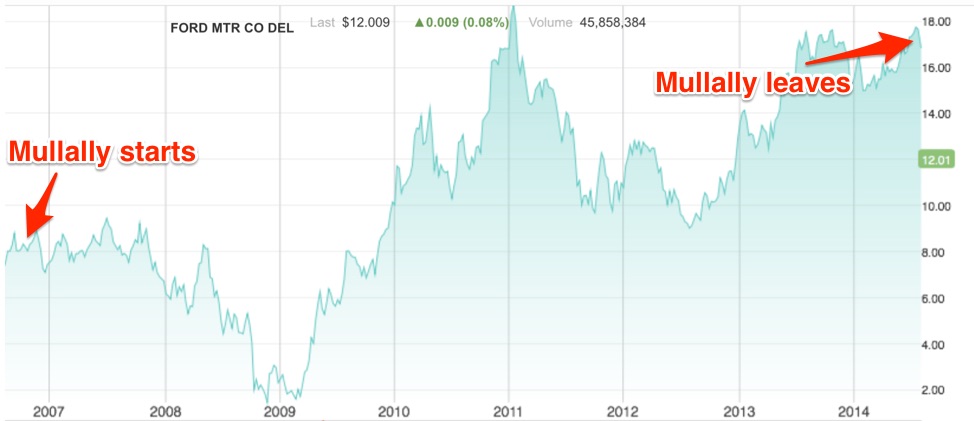
As Chief Executive for nearly 8 years at Ford Motor Company, he steered the company through the Great Recession (without taking a bailout), restructured the massive corporation to get the company more focused and streamlined, returned the company to profitability, and doubled the company’s stock price during his 8-year tenure as CEO. And he didn’t do it just by cutting jobs and laying thousands of people off.

Ford stock price performance under Mulally

Ford stock price performance under Mulally

And since his days at Ford, he was rumored to be in the running to replace Steve Ballmer at Microsoft, and later, to be President Trump’s Secretary of State. He currently sits on Board at Google (now Alphabet) and the Mayo Clinic Board of Trustees.

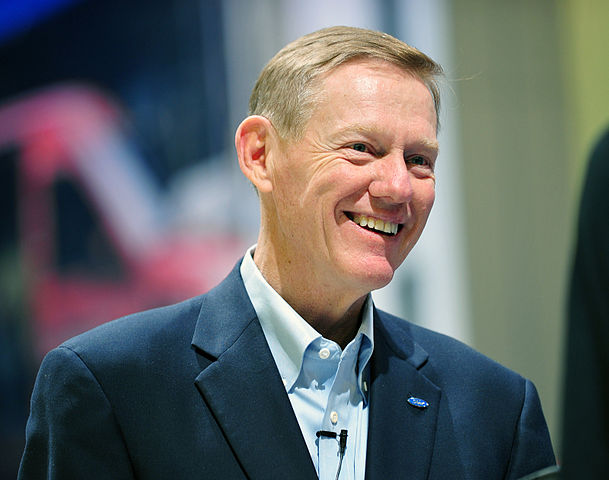
Alan Mulally (Image Source)

I’m not here to write his resume or publish a biography or write a blog post about his accomplishments. I mention these accomplishments because it’s the details that led to the turnaround that most people don’t know about.

Mulally came into a bleak situation at Ford, and 2 years later the great recession began. Yet Ford was the only US automaker to not accept a bailout. And he returned the company to record profitability.

Here’s how Mulally turned the company around, and what every manager can learn from him.

From Boeing to Ford

Mulally didn’t have an automotive background before coming to Ford. In fact, he wasn’t even a Ford employee. He was CEO of Boeing Commercial Airlines, leading the turnaround in that division and making Boeing more competitive with Airbus.

So without a background in the automotive industry and with no prior work history at Ford, his first job at Ford was CEO.

Starting as CEO

In September 2006, Executive Chairman and CEO Bill Ford called Mulally to ask him to run Ford. Mulally knew that Ford was a great American company, and that he couldn’t turn down the opportunity to serve an “American icon”.

He came to Ford on a mission – to save a great American company.

So what was the first day at Ford like for Mulally, who never worked at Ford, and didn’t even drive a Ford car at the time? What situation did he find himself in?

  • He drove into the company garage full of non-Ford vehicles. That’s right – all of the Ford employees that parked in the company garage didn’t even drive Ford cars. In short: they weren’t eating their own dog food.
  • His finance people told him that Ford was projected to lose $17 billion in 2006.
  • Ford was regionalized. There were Ford offices around the world, but none of them talked to each other. There was no synergy. None of the intellectual capability of Ford – the engineering, marketing, manufacturing – was shared.
  • And the contracts with the union (known as the United Auto Workers) essentially meant that they couldn’t produce cars in the United States profitably. The workers had a good salary and great pensions, all of which meant that the cost of goods sold increased to the point where already low-margin vehicles were unprofitable.
  • Their cars weren’t “best in class” and consumers knew it. The Ford brand itself was hurting. (Remember the acronym Found On Road Dead?)
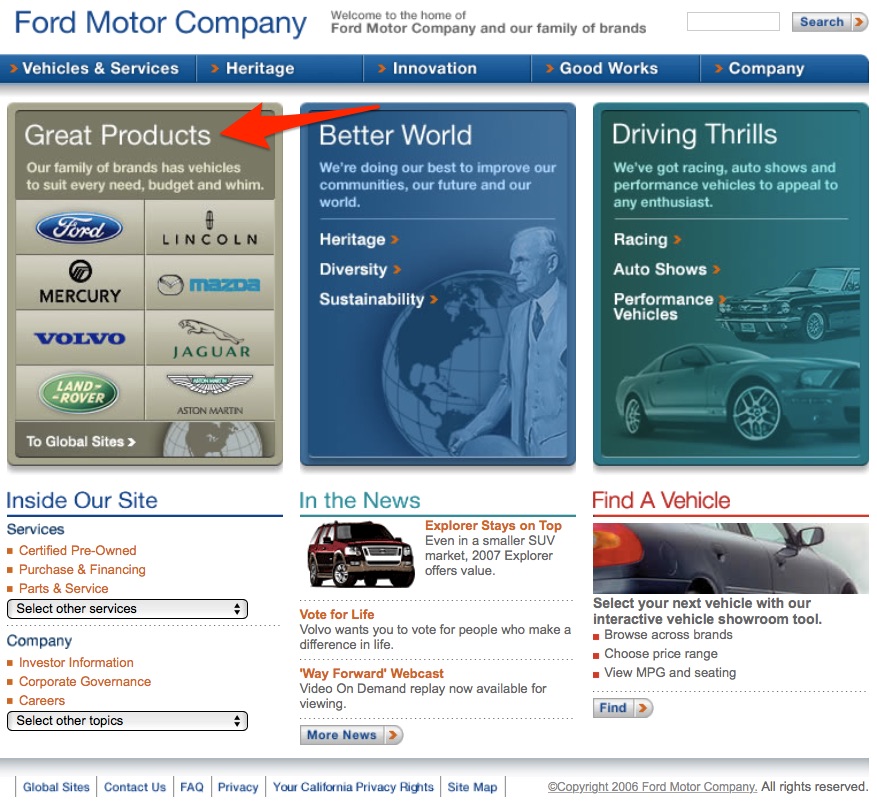
  • Ford Motor Company was not focused on, well, Ford. They were a “house of brands” that included Jaguar, Aston Martin, Land Rover, Volvo, and owned a 33% equity position in Mazda. Those brands were just “additions” to the Ford, Mercury, and Lincoln line of vehicles. This “family of brands” had 97 different vehicles. As Mulally says, “you can’t be world-class in 97 different things.”

The Ford homepage at the time Alan Mulally began as CEO

The condition sounds pretty bleak doesn’t it? And nothing like the Ford of today.

And so the rebuilding began. Mulally picked apart the business, finding each problem, and fixing each one. In many cases, this simply meant making a process or operation more streamlined and efficient. Bureaucracy was removed, blaming others wasn’t allowed, and team working wasn’t just encouraged, it was the culture.

Regionalized offices that weren’t communicating were now working together. And this new cohesive team looked at the situation honestly – a projected $17 billion loss – the biggest loss in its 103-year history. That crisis allowed them to pull together around a new strategy. They developed the strategy together by focusing on the Ford and Lincoln brand (Mercury was later discontinued), and producing the entire family of vehicles (cars, utilities, trucks) to be produced profitably and, as Mulally frequently says, best in class.

Everyone pulled together on this new plan and began executing. And they were going to do it all as one team. That’s what Mulally emphasizes – creating a plan, sticking to it, and working together as a team. Everyone is accountable to each other, and they help each other out when necessary.

The Plan to Turn Around a Company – On Four Bullet Points

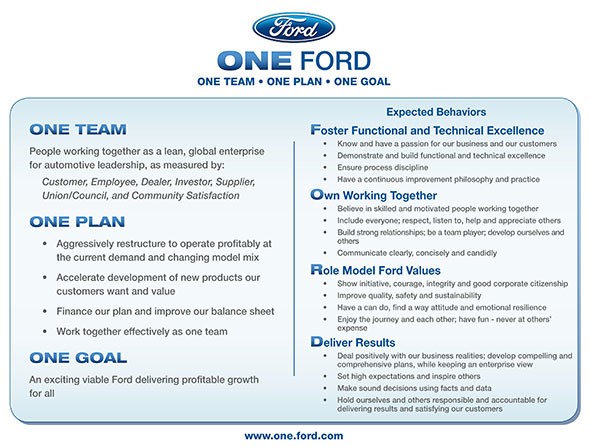
The new plan included these four bullet points:

  • Aggressively restructure to operate profitably at the current demand and changing model mix
  • Accelerate development of new products our customers want and value
  • Finance our plan and improve our balance sheet
  • Work together effectively as one team

Mulally printed it on wallet cards and distributed them to every Ford employee. Business plan on one side of the card, behaviors they expected on the other side.

The wallet-sized cards that each Ford employee received

He mentioned the bullet points constantly in meetings and with the press. And if you were around him enough, you’d likely be able to recite the four bullet points in your sleep.

Journalists covering the auto industry and Ford were tired of hearing it. But Mulally sticks to plans, even if people are tired of hearing them. If the goals of the plan aren’t achieved, he will continue to bring them up.

Listening to Your Critics

Every prominent company has their fair share of critics. Ford wasn’t any different. The Ford brand was severely damaged. The public viewed Ford vehicles as unreliable, with many referring to Ford with the acronym Fix Or Repair Daily. And Consumer Reports ranked them as one of the most unreliable car brands.

So what did Mulally do?

He met with Ford critics, namely he took his team to meet with Consumer Reports, who were one of the top critics of Ford vehicles.

Mulally and his team traveled and met with Consumer Reports product testers and discussed every Ford model. Product testers were critical. Mulaly didn’t argue with them or try to convince them otherwise. Instead, he used the trip to listen and understand their complaints. Mulally was grateful for the “unvarnished feedback” from the product testers.

A lot of companies live in silos and protect themselves from outside feedback. They make products without consumer input, and don’t talk to customers when they’re improving products or features. They build things nobody wants. Or worse, they’ll build something unreliable. That’s the fastest way to damage your brand.

Instead, take a lesson from Mulally. Find your legitimate critics (the ones who want you to succeed, but will give you a fair assessment) and listen to their criticism. Take it to heart and you’ll end up improving your product and processes.

The Weekly Business Plan Review Meeting

Mulally is an engineer by training. That engineering mentality means that he likes numbers. He likes to say that “the data will set you free”.

Data doesn’t lie and it doesn’t spin. It’s just facts that cannot be argued. And because of this, it’s great for showing progress and holding people accountable. Everything his executives managed could be deciphered down to numbers.

This data was used during the weekly Business Plan Review (BPR) meetings. These meetings, which took place every Thursday morning, brought Ford executives from around the world to discuss their departments and the progress they’re making on the business plan.

Bryce Hoffman, author of American Icon, explains the meetings:

Mulally’s management system, which he developed at Boeing, set clear and measurable goals for every aspect of the business. Each executive was required track their division or department’s progress against those plan goals and present it at a weekly “Business Plan Review” meeting.

The data was presented without explanation or excuses. It was also color-coded. Anything that was on plan was green, anything that was off plan was red and anything that was in danger of becoming red was highlighted in yellow.

Any issues identified in these sessions would be dealt with in a follow-up meeting known as a “Special Attention Review.” Here, discussion was allowed—but not recriminations or personal attacks. Mulally would say, “So-and-so has a problem, but he isn’t the problem. Who can help him fix it?” But this weekly return to the numbers also allowed him to enforce accountability.

The Ford Thunderbird Room, where the BPR meetings took place every Thursday morning at 8AM.

Here’s what every manager can learn from this:

How do you measure progress against your plan? Does your team know the progress? Are they working together and helping each other when necessary? Many companies like Google and Intel like to use the Objectives and Key Results framework to create goals and track them.

Creating a plan is great, but most organizations and teams don’t stick to it over a long enough time period. They hit the first road bump against the plan, and end up leaving the plan altogether.

As Mulally says, “We never give up on the plan. A plan is going to be the innovator for us to find new ways to find more opportunities to meet the plan and mitigate the risk. So it’s the all-time encourager of us to use our innovation to find solutions to allow us to deliver the plan rather than to give up.”

Working Together as One Team

“Working together” sounds pretty trite, doesn’t it?

It’s an overused term for executives, managers, and coaches. And lieutenants of those in management typically roll their eyes when they hear it from their superiors.

Yet Mulally didn’t just say, “we have to work together”. He created a culture of teamwork.

Before he came to Ford, there was infighting and elbowing among executives. Forbes described the culture Mulaly came into as, “Sharp elbows, fierce loyalties, and frequent turf battles were hallmarks of Ford’s management culture: The tough guys won.”

In response to this toxic culture, Mulally created the “One Ford” mantra. The wallet-sized cards were handed to every Ford employee and the weekly BPR meetings got all the executives on onboard and helping each other when they needed it.

During those BPR meetings, each executive brought an employee from his or her department to sit in on the meeting. And they don’t remain silent, sitting like students in a classroom. They are required to listen and give feedback.

Mulally and his executives often ask these employees for their thoughts and reflections on what is being discussed. Mulally says:

“We introduce the guests, who sit behind the team member that invited them, and we ask them for their reflections and thoughts. The guests might be an engineer or someone from down on the factory floor. So, all this data is flowing up, but then all the results are also flowing down. It is going back and forth every week at these meetings. And at the end of the meeting, the comments you hear from the guests make your eyes water. They say, ‘My gosh, this is so big, so vast. We’re in every country. I want to contribute to the plan as soon as I get back.’ I have heard many guests say that.”

Bringing the “lower-level” employees to the executive boardroom probably doesn’t happen at most of the world’s biggest companies. But Mulally understood how valuable these people are – and how the people “working the floor” and meeting one-on-one with customers and being hands on with the product can provide feedback that most executives cannot. This feedback inspires executives and the employees themselves. This sense of teamwork inspires everyone in the company to deliver results.

Understand the Value Proposition of the Company

What are you in business for? How do you make people’s lives better? How is the world better off because of your company? That’s what a value proposition should answer.

Mulally didn’t create a new value proposition for the company. Instead, he found the original one written by the company’s founder, Henry Ford.

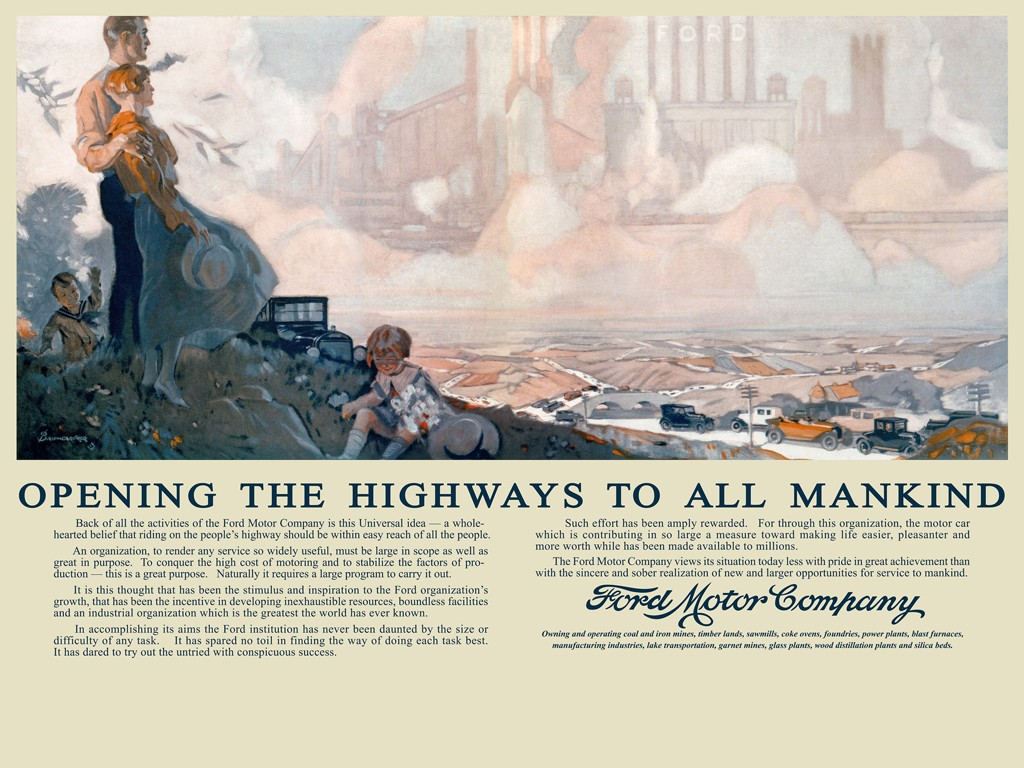
When Ford started, owning a car was reserved for the wealthy. Most people couldn’t afford to own a vehicle. Henry Ford’s mission was to change that and to “open the highways to all mankind.”

1925 Ford advertisement

This advertisement appeared in the January 24, 1925 issue of the Saturday Evening Post (Image Source)

Mulally believed in this value proposition so much that he hung it in the hallway of Ford’s headquarters and handed out copies to Ford executives. And all future product development would be weighted against the promise made in this value proposition. It may have been a value proposition created 80 years ago, but Mulally loved its message and what it promised. (If you haven’t caught a theme of this article, it’s that Mulally sticks to a plan).

Mulally with a painting of the advertisement

In keeping this value proposition alive nearly 100 years later, Mulally ensured that Henry Ford’s DNA and original vision would guide the company.

The takeaway here would be to truly understand your company’s value proposition and let it guide your future product development.

Conclusion

Starting a company and building it into a success story is quite a challenge, but taking over a company that’s damaged and returning it to the former glory days is a unique challenge and one that few modern executives have accomplished.

So, what was the method to Mulally’s success?

Was it his 12-hour workdays?

Nope, plenty of executives work hard and don’t deliver results.

Was it luck?

Anything but luck! Entering a company losing billions of dollars every year, then the Great Recession two years later and turning that same company into 19+ consecutive profitable quarters isn’t luck.

Mulally’s ideas weren’t new. Instead, it was sticking to those business fundamentals – teamwork, business plans, and delivering useful products that made Ford successful.

It was Mulally doing extensive research to understand Ford’s issues, and creating a plan (and sticking to it) and delivering results against that plan. It was the brutal honesty of being an outsider and assessing a company with a fresh eye. His inexperience in the auto industry but strong management skills are what made this turnaround special.

And it was Mulally’s commitment to a plan and people. As an engineer, he wasn’t expected to be a people-person. But he was – personable but tough. People who have spoke with Mulally say that he “makes you feel like you’re the only person in the room”. This kindness was paired with toughness. He was a hard-nosed businessman that expected results and delivered. He held his team accountable and created a culture of teamwork.

The end result was turning around an American icon from a battered company on the brink of bankruptcy to a competitive brand that grew the company profitably.

Quotes

Here are some Mulally quotes that I like:

  • “What does profitable growth look like? There are only two things you have to do – create products that people really do want and value and will actually pay for, and do it more productively than your competition. That means less resources and less time.”
  • “Always go back to that ‘what do we do here? What’s our brand? What do we stand for? And do we have a profitable growth plan? Because if you’re not profitably growing…you’re going out of business.”
  • “Good businesses grow at discounted cash flow, whether it’s cash or profits, by 15% a year. Most good companies grow the top line by 7% a year by making products people want and value, and then they also improve their productivity by 7%. And what’s 1.07 x 1.07? 1.15 – and that’s how you grow 15% a year. That’s what good companies do.”
  • “We never give up on the plan. A plan is going to be the innovator for us to find new ways to find more opportunities to meet the plan and mitigate the risk. So it’s the all-time encourager of us to use our innovation to find solutions to allow us to deliver the plan rather than to give up.”
  • “The first thing a leader does is facilitate connections between the organization and the outside world. You can only grow value and profits by 10 to 12 percent a year, which is what great companies do, if you satisfy customers better than the competition.”
  • “Leadership is having a compelling vision, a comprehensive plan, relentless implementation and talented people working together.”
  • “Communicate, communicate, communicate. Everyone has to know the plan, its status, and areas that need special attention.”
  • “The key became trusting the process—identifying the problems and helping each other find solutions.”
  • “Stress comes when you’re dealing with unknowns. Do what you can do. Then go home, get a good night’s sleep, and come in the next morning and try to turn a red into a yellow. It’s when you’re trying to do things alone, with no vision, that it gets bad.”
  • “Information should never be used as a weapon on a team.”

About the Author: Neil Patel is the cofounder of Neil Patel Digital.

Google

Increase Revenue Without Spending More on Marketing

email marketing campaign strategy

By now, you probably already have established plans to grow your revenue in 2018.  These plans likely include a mix of different iniatives aimed at attracting more leads and new business, and odds are good all these different iniatives cost money.

What if you could also generate an additional 10% in revenue without spending another dime on marketing?

FaceBook