Thursday, October 26, 2017

Inbound Marketing Is Not A Crockpot: How Reporting and Analyis Are Crucial To Inbound Marketing

email marketing in 2017

We’ve talked a lot recently about all the work that goes into Inbound Marketing, from the initial research and strategy development to actually executing all the many, many moving pieces. One thing we’ve alluded to, but not really discussed yet, is analysis, reporting, and adjustment.

Inbound Marketing relies heavily on marketing automation, so it may seem a bit paradoxical to have to stay so hands-on throughout the entire process, but the reality of the situation is that Inbound Marketing is not a Crock-Pot—there is no set-it-and-forget-it option!

Reporting and analysis are vital parts of your marketing strategy—parts that are easy to overlook—and they are the corners that are the easiest to cut when your marketing manager is overwhelmed.

You can drive and drive all day long, but if you’re not following your map, you could have taken a wrong turn 6 hours ago and ended up somewhere completely different from your intended destination—and you’ve wasted a lot of time and gas.

Inbound Marketing works the same way. You can spend tons of time developing personas, identifying goals, and creating and executing a strategy, but if you’re not generating the leads, then all that time and effort is wasted.

To keep your marketing strategy rolling on the track that will accomplish your goals, you must stop and evaluate your progress at regular intervals, figure out what’s working and what isn’t, and adjust your strategy.

The following issues are signs that you need to correct your course before you go too far off track:

FaceBook

Tuesday, October 24, 2017

Let User Behavior Shape Your Customer Engagement Strategy

email marketing for affiliate marketers

SaaS growth relies on customer engagement.

It can seem like an uphill battle garnering your audience’s attention in a competitive market. However, coupled with behavioral data, a personalized experience is one solution to communicating your product’s value.

“Chances are your customers have very diverse backgrounds, interests, and behaviors. A one-size-fits-all approach to customer engagement may alienate your customers and drive them away from your brand,” says Donte Ledbetter, growth producer of content and programming at Appboy.

You can serve customers better by monitoring user behavior. Below are five tactics to get your team moving in the right direction.

1. Identify Where Users Come From

Despite industry misconceptions, customer engagement isn’t a random phenomenon. Consumers don’t land on your website out of thin air.

There’s a reason for their behavior. Whether it’s a referral from friends or a backlink in a blog post, SaaS users arrive to your site with an internal (or external) motivation.

Some consumers possess an actual problem and think your product can offer a solution. Others don’t even recognize their looming challenge, yet find your product somewhat intriguing.

To begin the process of uncovering potential customers’ motivations, you’ll want to examine how they ended up on your site in the first place. These location origins will help your team develop a customer path that fits their interests and needs.

Kissmetrics Analyze makes this possible. The platform offers a chronological flow of user behavior wrapped into customizable reports. You can identify channels and monitor users’ steps in the funnel, from an initial visit to paid signup.

With this insight, you can engage users differently based on how they learn about your brand. You can optimize content and calls to action throughout the customer journey. For example, organic visitors may see a pop-up box to sign up for a product demo sooner than visitors from social media.

How consumers learn about your SaaS product matters. So take the time to analyze the data.

2. Spot User Inactivity

Throughout your career, you’ve learned that business centers around serving the customer. For some companies, this means catering to the constant demands of the consumer.

While this way of thinking works, it’s also important to recognize the actions of your customers. Their behaviors, not necessarily their current desires, provide your SaaS team with insight about purchasing decisions.

For instance, a trial user explicitly tells you she loves your product but never purchases. It can leave your team bewildered. However, if you observe her usage activity during the trial and learn she only tinkered with the application twice, your team is better equipped to ensure conversion.

Product usage data is invaluable for engagement. With the right strategies in place, you go from churning to closing more sales.

Kissmetrics Populations can help you quickly identify trends in user activity and product usage. Here’s a video explaining how it works:


“The critical barrier to harnessing the potential value in this shift is organizational—companies that learn to design and execute effective customer-engagement strategies will have the advantage; the others will lose ground,” writes Tom French, a director at McKinsey.”

Drops in user activity indicate a break in the customer-brand relationship. Take proactive measures, like sending retention emails or offering one-on-one training, to lure users back to your platform. It’s up to you to earn every user’s attention.

3. Monitor Social Media Interactions

When diving into user behavior, it’s easy to get tunnel vision. You focus entirely on the data that you deem vital for SaaS success.

But like most business functions, customer interactions extend beyond your SaaS product into other channels. For instance, consumers may learn about your product on Facebook and comment on your posts with questions.

These social platforms aren’t controlled by your team. Yet, they can become one of the best forms of engagement with your users. They’re already talking with their friends, so it’s convenient to drop your brand a message, too.

Consider these social interactions an investment. A Twitter research study found that “when a customer tweets at a business and receives a response, they are willing to spend 3–20% more on an average priced item from that business in the future.” Plus, customers are 44% more likely to share their experiences.

Image Source

Social listening is helpful for determining how to engage your customers. If users begin to complain about a specific product feature, you’ll want to respond quickly and escalate the issue to your product team. Similarly, when users praise your business, you want to acknowledge their compliments and show the comments to your team.

Engaging on social is more about learning from the customer than boasting about your product. Take action on their concerns to increase SaaS growth.

4. Track User Responses to Communications

Communication is key to ensuring strong customer engagement. Your team probably spends hours crafting the perfect message to convey exactly the right tone and details.

That’s commendable. But do you also pay attention to how SaaS users respond to your messages?

From email to live chat to phone support conversations, your users are giving you verbal and nonverbal cues about how they perceive and feel about your brand. User response is pivotal to discovering what makes your customers tick.

Let’s say your Net Promoter Score drops after users talk with your live chat representatives. You should then dive into the language used by customers during the chat.

Are users saying terms, like ‘upset’ or ‘stupid’? Then, you can take a look at when those frustrations occur and for what product issues.

From another angle, you can use current user behavior to trigger how you reply to customer responses. You may send an email about an upcoming product launch. The user opens the message but fails to click a link in the email.

You can track that behavior and follow up with another email or even segment an entire group to receive a different series of messages. Kissmetrics Campaigns gives your team the flexibility to send these types of personalized emails based on user behavior.

5. Recognize High-Level Product Adoption

According to the Aberdeen Group, best-in-class businesses “achieve an 80% greater customer retention rate” compared to other organizations. It’s because they have “mastered the science (and art) of creating loyal customers.”

Loyalty isn’t reserved only for well-known brands. Microsoft and AirBnB do not own a share of die-hard consumers.

Your SaaS can earn customer loyalty just like the competition. By plotting the behaviors from visitor to power user, you’ll know exactly how to nurture incoming users.

Of course, behaviors will vary depending on your industry, customer type, price point, and product, but there’s still specific actions to track.

As a SaaS team, observe how often users log in to your application, the number of times users submit a service ticket, and the usage of advanced features. You’re looking for patterns that indicate a threshold of product adoption above standard users.

These behaviors will prepare your team to send new users down a similar journey. For example, if power users sign in five times a week, you can send an email to new users reminding them to log in to your platform. This way, you’re making a conscious effort to build a habit of loyalty.

Let data move your SaaS business toward more revenue. Past user behavior can produce future customer loyalty.

Engage With User Behavior

It’s time to upgrade your customer engagement. Infusing user behavior into your strategy leads to better experiences.

Start by identifying how users learn about your site. Then, pinpoint gaps in user activity to prevent churn. And always listen to customer feedback to improve the product.

Focus on user behavior. Then, shape your customer engagement.

About the Author: Shayla Price lives at the intersection of digital marketing, technology and social responsibility. Connect with her on Twitter @shaylaprice.

FaceBook

Monday, October 23, 2017

Low Sales? Here’s How to Read Minds to Close More Deals

email marketing landing page

People either do what you want. Or they don’t.

And there’s not a whole lot you can do about it.

Except react. Except follow-up based on a new set of rules.

That doesn’t mean you can’t predict it, though. That doesn’t mean you can’t manipulate it. It doesn’t mean you can’t choreograph it ahead of time.

Almost every single customer interaction presents an IF/THEN scenario. They either choose to do one thing, do the opposite, or do nothing at all. And each option means you should react in a slightly different way.

The good news is that you can do it in advance. You can determine what happens, before it happens, so the message they receive next is always the right one.

Here’s how to get this insight and react in real-time to give people exactly what they want, when they want it.

1. Start by setting objectives

Personalization isn’t “Hey $FNAME.”

It’s deeper than that. It’s about collecting various data points so you understand context. So you ‘get’ what someone wants before they want it.

In a Spy’s Guide to Strategy, ex-CIA case officer, John Braddock, says that creating a strategy comes starts with two moves:

  1. Identifying someone’s potential end game, and then
  2. Reasoning backwards to figure out how they get there.

That way, you can see what’s coming. Only when you know where someone is trying to go can you create scenarios for how they might get there.

Content mapping is a perfect real-world example.

Image Source

Some people come to your site to buy. But not most. Only a tiny slice ready to hit the Product Tour and Opt-in page before reading “Thank You.”

Others want pricing. Some want insights. And still more want information.

Which is why content mapping says you gotta give all those things to all those people. Make them stick around. Get them to click. Get them to come back.

The trick is to start here. Without determining who wants what, you can’t figure out how to get them there the fastest and easiest.

Marketing isn’t a singular campaign today. It’s not a banner ad or a drip email sequence.

Instead, it’s a series of IF, THEN statements. Conditional statements that show how people get form A->B, and then somehow to Z.

Z is what you want. Z is where you purchase. But people don’t start with Z.

That’s why you break the process down. A->B becomes a micro-conversion. It’s the step between the step. The guy behind the guy. That eventually makes stuff happen.

You start by hypothesizing. You try to infer what someone wants. Then comes the “then.”

Image Source

“Then” is when stuff happens. It’s your response.

Product companies are relatively simply. People check out a product but don’t buy. So you follow-up with retargeting efforts.

Easy, right?

Not so much for services. The sales process takes months instead of weeks. It takes nurturing instead of discounts.

Let’s say someone checks out your services. They check out some key pages. But they don’t opt-in.

“Free consultation” time? Not necessarily. That’s also not very inspiring.

So you switch it up. You could try an offer to get them to realize how much they need you. You need to make the pain real. You need them to place a dollar value on it. Otherwise, no sale.

That starts with a 1-1 conversation. It’s a spin on the “Free Consultation.” Except it doesn’t suck. It’s focused on their issues, not your own.

The goal: Get people who checked out our Services into this new 1-1 offer.

Next, you work backwards. You set-up the sequence to determine how someone is going to get from A->B.

Automation workflows can help you map this out. For example, if someone looks at the services page but doesn’t convert, do this next.

“This” could be “send new email.” Perfect.

Now do it again. This email goes out. Do they click on the CTA link?

Yes or no.

If yes, but they don’t sign up for your offer, it’s a no. Or it might as well be. So respond accordingly.

These sequences repeat ad nauseam.

There are no limits. That’s the beauty. And with some iteration, you can automate most of the entire process.

Setting a clear objective like that leads you seamlessly into the next step. Select your segment.

Except, you don’t create these segments out of thin air. Or you shouldn’t.

You should let people tell you where they belong.

2. Segment new leads

How do people get to your site?

They could punch in the URL directly. They could serendipitously run across your blog post on Twitter. Or they could find your aforementioned Services page by clicking on your Google ad.

Each of these are different channels, sure. But they’re more than that. They’re giving you more information than that.

✅ The direct website visit? Brand-aware. Been to your website multiple times before. Probably transitioning from stranger to lead.

✅ Twitter? New visit. Stranger. Needs more info to develop brand recognition.

✅ Google search ad? Also not brand-aware. But problem-aware. Probably solution-aware. Show them why you’re better.

Now, keep them separate. Don’t treat them the same.

Their under-the-radar behavior is already telling you something important. So keep it going by segmenting their journey.

Create different flows. Create different segments for each.

Image Source

Sometimes you have control over this. And sometimes you don’t.

For example, if you’re creating an ad, you control the landing page destination.

When you’re writing a blog post, you can control the internal links or other navigation elements they see.

But when someone finds something from organic search? You can’t always control everything.

Once again, marketing automation platforms can tell you the trigger. They can tell you the exact page someone visited. First. So you roughly know who they are or what they’re looking for.

They could leave your site right now and it would be OK. They could get distracted. Bounce. And you’d be fine.

‘Cause you’ve got the same ability to retarget in other places based on individual page views.

create audience custom combination Facebook

Image Source

You can see which of the three products they clicked on. You can see which of the five services they expressed the most interest.

That tiny clue adds context. You should know what to follow-up with.

Similarly, someone views your opt-in form but doesn’t convert.

No prob. You can still follow up. You can still tailor the message based on their non-action. You can cycle through common objections until you land on what that sticks.

This is where personas often fail. This is where ‘segments’ often don’t work.

Your decision-making data should come from people’s actions. Not just your own hunches.

3. Nurturing & re-engagement

Eventually, someone opts-in.

Someone finds something like they like and gives you something in return.

On the one hand, it’s great. You’re one step closer.

Except on the other, it changes everything. You need to update things. You need to evolve the conversation.

For example, let’s say someone downloads an eBook. Then your free trial or 1-1 offer. Both good things.

Except, it creates a rippling effect.

For example, you need to work backwards before you work forwards. You need to remove people from previous sequences because their status has changed.

Those top of the funnel eBook nurturing emails worked. Wonderfully! But now that they’ve moved deeper, they need a new sequence. Only after removing them from the previous one.

Bad news, though.

One person moved forward. They went from TOFU to MOFU or BOFU.

But most don’t. Or won’t.

So let’s plan for that, too. Someone downloads the eBook. Maybe they even enjoy it. But after the first few weeks, nothing else happens.

They received the same nurturing emails. But decided against taking you up on the next offer. For whatever reason.

Same objective as the first, but a new segment this time.

What’s happening here:

  1. It’s been at least 35 days since someone downloaded the eBook. The reason? It gives your other campaigns at least four weeks to try and move them down the funnel.
  2. Unfortunately, it didn’t work. The individual didn’t opt into any other offer you threw at them, either. No other forms were filled out.

Cool. No worries. Water off a duck’s back.

IF, you saw this coming. IF, you have a scenario planned out for them.

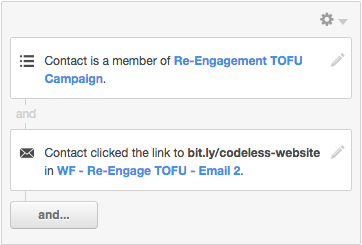
Typically, you want to get them to ‘reengage’ here. So new emails go out. Each, with different links like this next one.

Those are all unique links. They’re split up by topic. You’re setting a trap. You’re baiting a hook.

For someone’s action to once again tell you how to better segment them.

Let’s say someone clicks on the fifth option down: “Optimizing Your Website.” That indicates they’re interested in, well, updating their website.

Cool. You saw this coming. Savvy marketer, you.

That pulls them into a brand new segment. Seamlessly and automatically.
Now, you can tailor the next few messages better. You can send them website-related tips, instead of SEO ones. You can send them more relevant offers that they’re more likely to take you up on.

Which puts you one step closer.

4. Sales qualification

Ecommerce is easy. Someone buy’s or they don’t. Most customers are ‘good,’ as long as they’re paying.

Services ain’t easy. Most leads and prospects won’t become customers.

In fact, you can take this a step further. A small segment of people will want to work with you. But for a few different reasons, you won’t want to work with most of them.

You want the best customers. You want those that will be the best fit. The ones that ideally also have the longest lifetime value.

Which means you need to qualify. Which means you need to plan for this in advance.

You know many people who fill out your form won’t be a good fit. So you add a couple qualifying questions to the bottom of your form.

“Annual Revenue Range” can tell you a few things. It can tell you, right off the bat, if they can even afford you. Not worth jumping on the phone if they can’t.

But it can also tell you what product or service they might be best suited for.

As does “Biggest Marketing Challenge.” It helps you figure out what solution to line up with their problem.

It also helps you logistically. The person or division doing $100,000 websites will be different than the one doing $1,000,000 ad campaigns. So they need to be routed appropriately, too.

Now, think of your process and workflow. Each little decision or potential answer has another trickle down effect. It influences everything that happens afterward.

You need filters and branches and IF/THEN statements along the way. That way, you can take all of the various possibilities into account.

Before they happen. So you know exactly how to respond. When it eventually does.
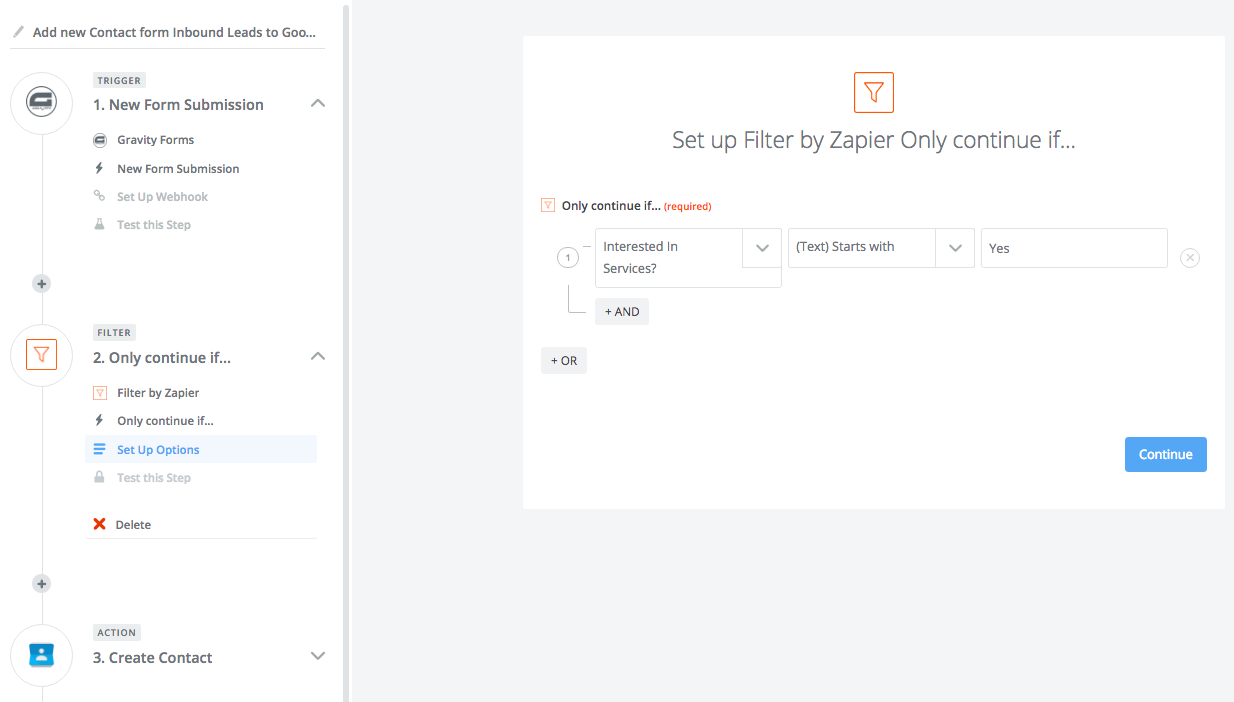
Different sequences need to kick off when someone selects “Yes” vs. “No.”

Different people need to be notified. Different tasks and steps needs to come next.

Conclusion

Congratulations. You’ve made it this far.

You’ve sold a new deal. Closed a new account. Brought in a few bucks.

But a new customer isn’t the end of the process, so much as it’s the beginning of a new one.

“Marketing” doesn’t just mean advertising, after all. Onboarding is crucial. Customer service is key.

Keeping that account longer means more money in your pocket. Easier money than bringing in a new deal.

Retention is your job, too.

Which means you’re not done. Which means there are more scenarios to account for. More sequences to create.

Marketing isn’t isolated. It’s not one-and-done. It’s systematic. It’s a process. It’s a series of IF/THEN sequences.

People do what they want. They decide or click or opt-in or don’t. You can’t control that.

You can only control how you react and respond. Or how you lead them to do what you want.

About the Author: Brad Smith is the founder of Codeless, a B2B content creation company. Frequent contributor to Kissmetrics, Unbounce, WordStream, AdEspresso, Search Engine Journal, Autopilot, and more.

Youtobe

Thursday, October 19, 2017

3 Kissmetrics Populations Content Marketers Can Use to Measure Marketing and Retention

email marketing plan template

Content is basically infinite. Run a Google search for a/b testing and you can spend the rest of your life reading about it.

So in this proliferation of content, it’s retention, attention, and engagement that are key for content marketers. It’s our goal to get visitors to our content, ideally more than once, and eventually get them to convert in some way.

Converting usually starts at the very top of the funnel, by giving eBooks, webinars, email courses, newsletters, content upgrades, etc. Then they’ll be put through a drip campaign to eventually, hopefully, signup or request a demo.

Before we begin, it’s important to be aware of what Kissmetrics Population is, what it does, and who it’s for. This video will explain it:


Now, let’s get into some Populations Content Marketers can set up.

1. Reader Retention

You probably have about 10 websites you visit regularly. Most of them you visit daily, but some others you’ll visit every other day.

I regularly visit Axios, ESPN, the Kissmetrics Blog (of course), New York Times, Drudge Report, Twitter, and ScienceDaily. I’m an engaged visitor on these sites because I visit them regularly. The publishers love a visitor like me because I am traffic, pageviews, and ad dollars for them. And most of all, they get a piece of my attention everyday.

Wouldn’t you love it if your blog was on someone’s “top 10” list? They read your blog posts, download your eBooks, and you’ve become a trusted source for them. Some may call you a “thought leader” (as much as I dislike that term).

Most marketers use cohort reports to measure retention. These reports group people together based on similar attributes and then track their behavior overtime. This can uncover some useful data. There are also “engagement” metrics that can be measured by any actions a reader may take – reading a post, commenting, sharing it on social networks. These can be easily measured with a simple funnel report.

But what about simply tracking the number of people that have visited your blog at least x times during the last week, and then have a graph to see if it’s going up, down, or holding steady?

Populations will do exactly that. You’ll set your conditions (what people have to do enter the Population) and view the graph.

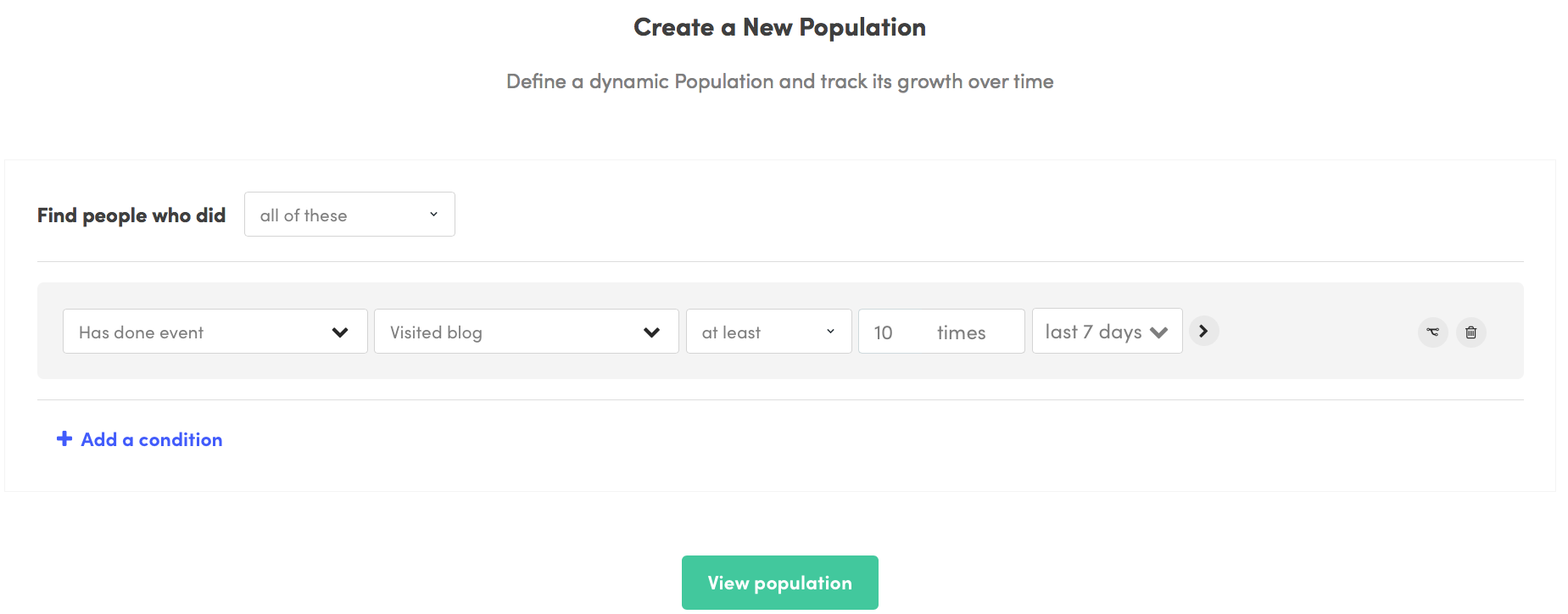
In our case, we’ll set our criteria to people who have visited the blog at least 10x in the last 7 days:

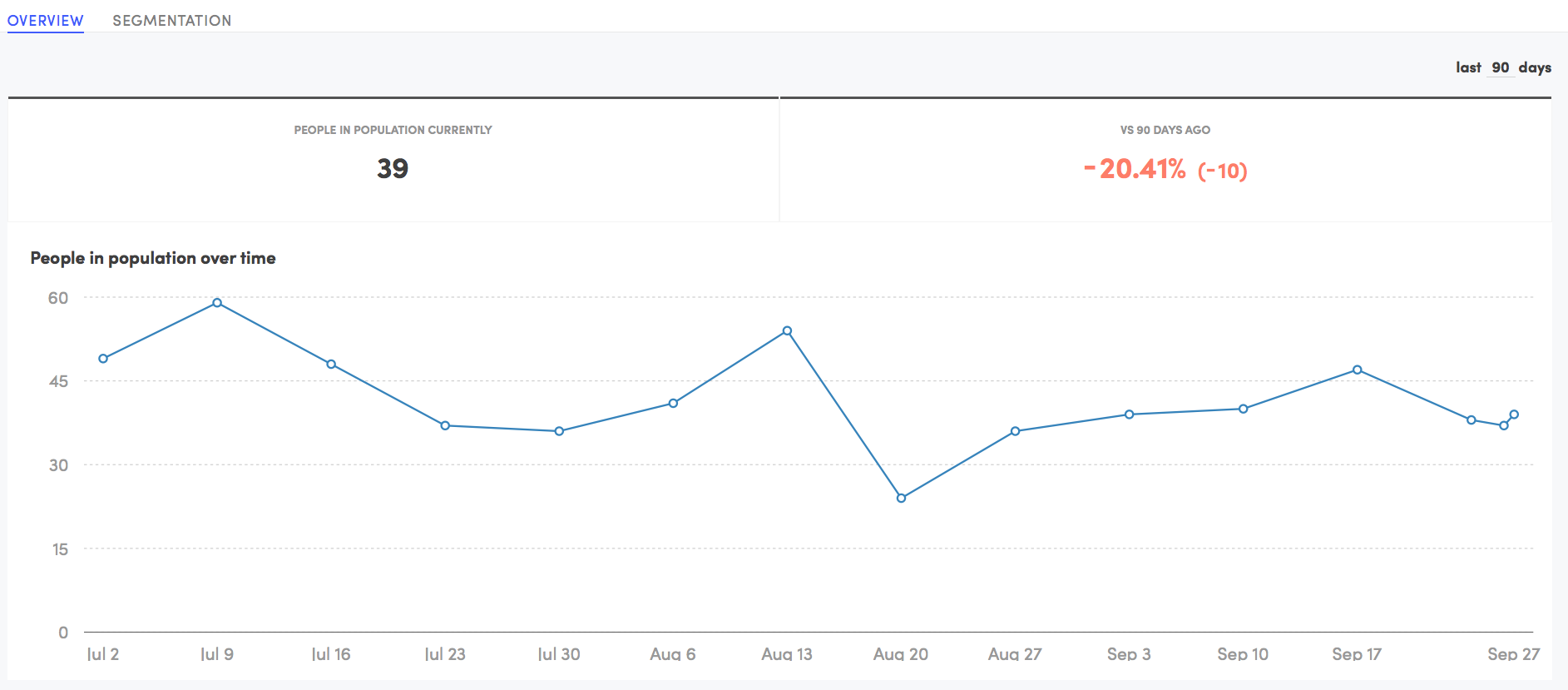
We’ll click View population and get our data:

At the top, we see that there are currently 187 people in our Population. The graph provides us with a week-by-week performance overview. This Population has improved modestly, up about 2% from 90 days ago. It’s ultimately held steady over the last 90 days, staying in the 150-200 range.

What’s important here is to view this in context. Let’s say you have 10,000 monthly readers and your Population holds steady at 1,000. In this case, you know that about 10% of readers are engaged with your content. But if you have 1,000,000 monthly readers, than that 1k Population is less impressive and may signal that you need to create more engaging content that people want to read and consistently check to see what you’ve published.

2. Signups & Conversions

At the end of the day what we want are signups or some form of conversion. A blog that gets 5 million visitors a month but doesn’t convert is about as good as not having a blog at all.

We’re graded not just on traffic, nor on reader engagement, but on how effective our content is at bringing quality leads to our sales teams. HiPPOs care most about this and it’s our job to produce relevant content that brings our target audience in, and then converts them.

You may already be tracking your conversion rate with our Metrics feature, but it’s also useful to use Populations to get an idea of the amount of people that are moving from reader to converter.

Now, the question is what a “converter” is. Each team will differ. Some marketers want an email address so they can convert this reader into an opportunity through a drip campaign. Others will qualify a free trial request as a conversion. E-commerce companies may having adding an item to the cart or purchasing as their conversion.

Regardless of what you’ll count as a conversion, it’s easy to track it in Kissmetrics and Populations.

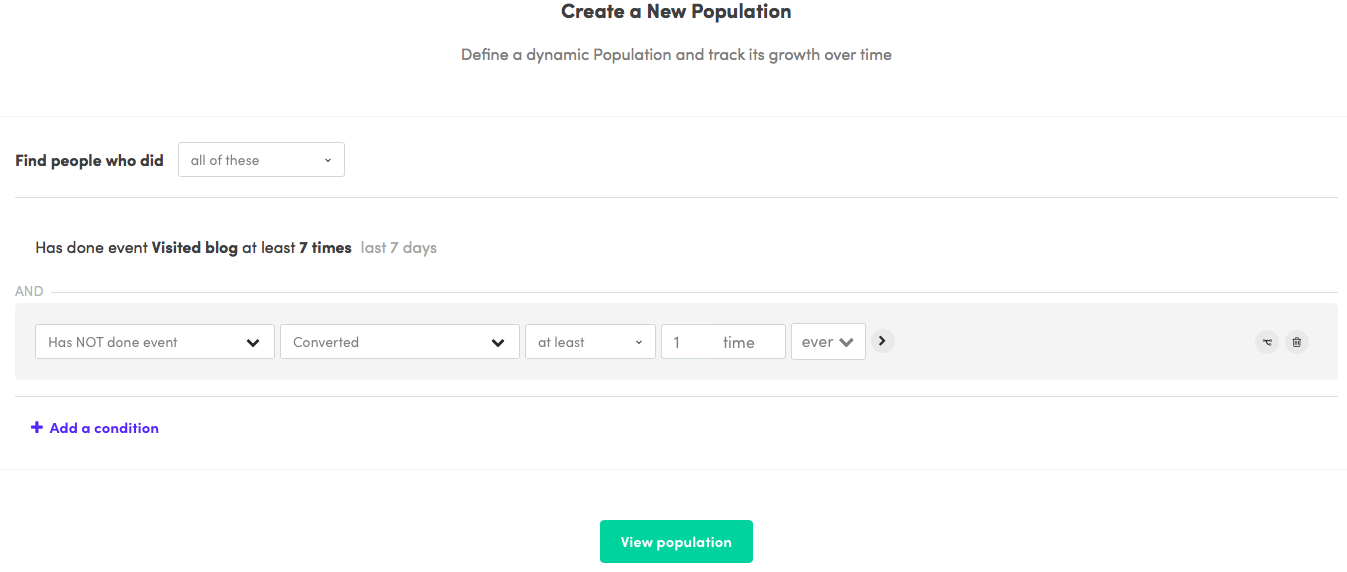
You’ll notice that in this configuration, we’re looking for the people who visited the blog and then signed up. They cannot visit our marketing site, sign up, and visit our blog because they need to visit the blog before signing up. If they visited the marketing site, the blog, and then signed up, they’ll be included in this Population.

Not good. It’s down 20% from where it was 90 days ago. We need to figure out why this happened.

In some cases, this can be caused by a/b tests that caused a drop in conversions. In other cases a traffic dip will cause conversions to drop. (As long as the conversion rate percentage holds steady). We’ll need to look at our traffic to see if there was a dip that would correlate with this Population drop. If not, we’ll have to dig deeper to see what could be causing it.

3. Visited Blog x Times But Haven’t Converted

Engaged readers are great, but if we’re not converting them to our content upgrades, webinars, eBooks, or even signing up, then we’re not doing a good job marketing our content (or product).

This Population tracks the number of people that visit your blog many times each week, but never convert. It’s simple to set up, just enter your criteria as “people who visited blog at least x times in the last 7 days and have not converted.”

This will do exactly as it says – track how many people are visiting the blog regularly without converting. We can expect this Population to go up with traffic increases, but if it shows a trendline above overall traffic, that might indicate that we’re not converting our readership.

Let’s view our Population:

So about a 22% increase compared to 90 days ago. As in all Populations, these numbers need to mean something in context. If our overall traffic has remained flat, we can try some new tests to get more of our regular readers converting. Maybe some retargeting will help (which would link to a landing page for an eBook) or other tactics that can drive conversions – exit-intent popups, content upgrades, etc.

Conclusion

As a customer engagement automation platform (CEA), Kissmetrics is made to help you analyze, segment, and engage your online audience. Request a demo today to learn more.

About the Author: Zach Bulygo (Twitter) is the Blog Manager for Kissmetrics.

Google

Tuesday, October 17, 2017

Growth Hacking vs. Growth Mapping: What You Should Be Doing To Scale Your Business

email marketing advantages and disadvantages

So, you’ve tweaked your landing pages until your conversion rates can’t get any better, split tested every facet of your ad campaigns and collaborated with influencers in your niche to maximize your exposure.

What’s next?

These tactics are wonderful and can generate explosive growth, but after a while, you’ll reach a plateau.

Once your startup is a fully-fledged, profitable business, growth challenges become different. While a startup is focussed on big wins to make the cash register ring, established businesses need to think in terms of more stable, incremental forms of growth. It’s no longer about growth hacking; growth mapping has to take center stage.

This continuum of business growth can be explained using sports as an analogy.

Mixed martial arts have one of the most significant learning curves out of all sports.

In the first six months of training, you can learn the fundamentals of striking, wrestling and jiu-jitsu.

However, the longer you practice, the smaller the improvements you’ll make. Once you’re proficient at the basics, the real journey to mastery begins.

Sure, adding a spinning wheel kick to your arsenal of attacks is beneficial in the short-run, but elite level UFC fighters didn’t reach mastery by continually learning new techniques – they did it by refining their fundamentals, year after year.

Jiu-jitsu expert Demian Maia understands all facets of the game, but he didn’t start achieving spectacular results until he centered his strategy around his strongest skills: wrestling his opponents to the mat and securing a rear-naked choke. Fans often comment that his opponents know exactly what he’s going to do, yet are unable to stop it.

To achieve mastery in any discipline (especially business), tactics that provide short-term explosive growth are great – but the long game requires slower, sustainable progress.

This is the difference between growth hacking and growth mapping.

Whatever stage your business is at, consider using these growth tactics to take you to the next level.

1. Growth Tactics

Here are some non-technical growth tactics to try. These don’t require a/b tests or changing any forms to increase conversions. Instead, they’re simple tactics to test to see if they drive meaningful acquisition.

Personalized Discounts

The generic, one-size-fits-all approach to marketing is no longer applicable.

Nowadays, businesses can leverage user data to deliver more personalized, emotionally resonant messages to their users in order to maximize engagement and profits.

Email marketers have a good understanding of this. Depending on the actions people have taken in response to email campaigns, different email sequences can be fired off.

If a person opened an email promoting a webinar and attended, they might receive a sales-oriented email, whereas if they miss the webinar, their next message might be a gentle reminder of when the next webinar is available.

To take this a step further, I recommend using your analytics data to provide special deals to warm prospects. If a person has viewed a product page numerous times but hasn’t converted – there is a proven interest but something isn’t quite right.

In my experience, offering limited discounts to these users can push them over the edge and get them to convert. In this scenario, leveraging scarcity marketing in a highly personalized way can drive explosive growth.

Incentivized Referrals

Instead of pumping money into ad campaigns to acquire new customers, have you ever considered getting your existing customers to do your marketing for you?

In recent years, Dropbox and Airbnb have achieved extreme growth partially due to referral marketing. However, PayPal created the blueprint many years prior.

Initially offering $20 to new users and $20 for them to refer their friends (this was later scaled down to $10 and then $5), PayPal acquired over 100,000 users in the first month of being operational.

The bold referral program was masterminded by PayPal co-founder, Elon Musk. A consummate scientist, Musk described the viral nature of the program as “bacteria growth in a Petri dish.”

While you may not be able to spend tens of millions of dollars like PayPal did to acquire new customers, a good double-sided referral program (both the referrer and friend benefit) can stimulate tremendous growth.

If you’re not ready to create a formal referral program, consider sending your repeat customers a referral discount code via email. Since they have a positive impression of your brand (proven by repeat purchases), they’ll be happy to refer their friends to you – especially if they’re incentivized to do so.

Guest Posting

A few years back, people used guest posting for all the wrong reasons. In order to game search engines and acquire inbound links, marketers would submit sub-par content to external sites with no concern for providing value to the audience.

Fortunately, Google caught on to this unsavory practice and it’s being phased out.

However, Google is still perfectly happy for people to publish guest posts that, “inform users, educate another site’s audience or bring awareness to your cause or company.”

In other words, guest posting is no longer a link building game; it’s all about delivering value and long-term brand building.

As a free growth tactic, I find guest posting to be exceptionally effective. I aim to write multiple guest posts every week.

If you don’t consider yourself a particularly strong writer, you can hire a quality ghostwriter. You can expect to spend between $150-$300 per post. Make sure you find a quality guest writer that is an expert in their niche. They should have published on reputable blogs before, and are not a “jack of all trades”, meaning they can write on daycare blogs and b2b marketing blogs. Find writers that stick to one niche.

For startups, I recommend saving your best content for guest posts. This sounds counterintuitive, but guest posts will be read more than the posts on your site – so it makes sense to deliver the most value where you’re receiving the most eyeballs.

Gamification

If you’ve ever played the old school MMORPG game, Everquest, one of the most compelling features of the game’s interface was the experience bar, which would tell you how close you are to moving up to the next level.

LinkedIn use a similar gamification tactic to encourage new users to fill out their profiles.

linkedin incomplete profile

There is a core psychological component to gamification tactics such as progress bars.

Research indicates that the simple act of completing something, whatever it may be, leads to a release of endorphins. When the act of completion is associated with positive emotions, you’re compelled to keep completing things – which leads to a large user base for both SaaS companies and MMORPG games!

Think about how you can incorporate gamification into your user experience and you’ll reap the rewards.

Free Merchandise

In the digital era, free merchandise (a.k.a. swag) can seem like a pretty low-tech growth tactic, but this is exactly why it’s so powerful – because not many people are doing it anymore.

By handing out branded t-shirts, mouse pads, pens and other accessories, you can let your free merchandise do your marketing for you.

Counterintuitively, you don’t need a huge upfront investment.

I recommend browsing Alibaba and conversing with manufacturers. You can get your logo branded on a gigantic range of products – just shop around for the right price.

Sometimes, manufacturers will be happy to drop ship your orders, so you don’t have to hold inventory.

Instead of handing out gifts to everyone and anyone, I recommend shipping free branded accessories as rewards to customers who have a high Customer Lifetime Value (LTV).

Someone who has made repeat purchases already holds your brand in high regard, so they’re more likely to show off their free t-shirt or pen to their friends. Since they’re already a profitable customer, you’re not going to lose money on sending them a free gift – whereas you might with non-customers or one-time buyers.

Print on demand t-shirts work excellently in this scenario.

2 – Growth Mapping

Growth Scoring

Once you’ve exhausted all possible growth tactics, the first step to sustainable growth is to examine what’s working and what isn’t.

If content marketing is a core part of your company’s success, I’d recommend tracking key metrics for your campaigns.

When doing growth scoring for clients, I like to be as in-depth as possible. Before moving onto the subsequent mapping phase, I need to be able to answer the following questions:

  • What is the ideal blog post length in terms of generating engagement?
  • What is the ideal article title length?
  • What’s the average bounce rate and time spent on pages?
  • How many social shares are generated per post?
  • Do some types of content create more engagement than others (i.e. infographics and video posts)?
  • Do articles by certain authors perform better than others? If so, why?

Strategy Mapping

After analyzing our scores, we can tell where we should maximize our investment to get the best returns.

For instance, if infographics consistently perform better than blog posts (in my experience, they often do) – allocating additional resources to producing infographics will be beneficial in the long run.

Also at this stage, we have the opportunity to revisit highly performing blog posts and optimize them.

One of my favorite optimization tactics is to provide downloadable content upgrades at the end of these popular posts.

A content upgrade is simply a lead magnet (a checklist, eBook or other item of value that marketers trade in exchange for contact information) with one key difference: they’re contextually relevant.

If you’re a marketing agency, you might feature a lead magnet on your homepage in the form of an eBook about driving website traffic. However, if you’ve seen that an evergreen article about email marketing continually gets lots of views – you might want to provide a checklist at the end of the post describing the steps to creating a killer autoresponder sequence.

Growth mapping is all about examining the data, and then mapping out a course of action for sustainable long-term growth.

Have you used any other growth hacks that have been effective for your business? Please let me know in the comments below, I’d love to hear your replies.

About the Author: Aaron Agius, CEO of worldwide digital agency Louder Online is, according to Forbes, among the world’s leading digital marketers. Working with clients such as Salesforce, Coca-Cola, IBM, Intel, and scores of stellar brands, Aaron is a Growth Marketer – a fusion between search, content, social, and PR. Find him on Twitter, LinkedIn, or on the Louder Online blog.

Youtobe